


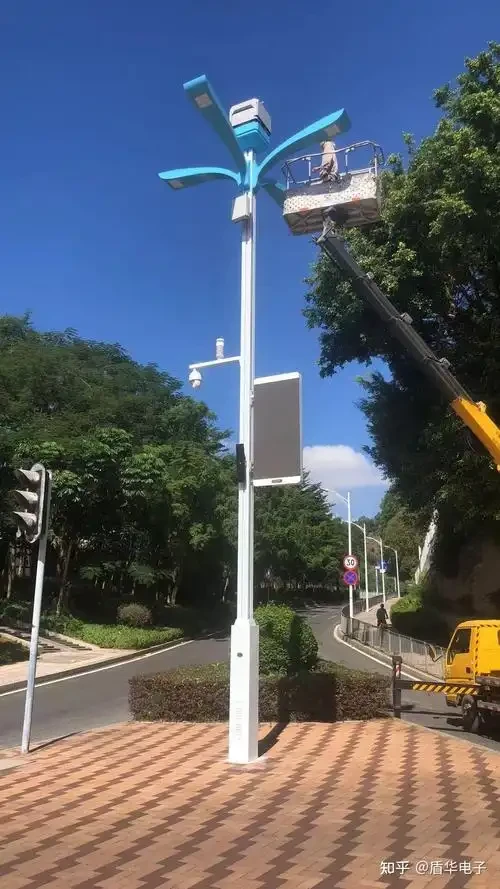
What Are IoT-Enabled Smart Street Luminaires?
Definition
IoT-Enabled Smart Street Luminaires are intelligent LED lighting fixtures equipped with wireless communication capabilities, sensors, and embedded control logic that connect to centralized management platforms. They transform passive lighting infrastructure into active, responsive urban assets that can be remotely monitored, controlled, and optimized.
How Smart Luminaires Differ from Traditional Lights
| Comparison | Traditional Street Light | IoT-Enabled Smart Luminaire |
|---|---|---|
| Control Method | Fixed schedule or manual | Real-time, adaptive, sensor-driven |
| Energy Management | On/off only | Dynamic dimming, adaptive brightness |
| Fault Detection | Manual inspection | Real-time alerts, automated diagnostics |
| Maintenance | Reactive (fix when reported) | Predictive (fix before failure) |
| Data Collection | None | Energy usage, performance, environmental data |
| Scalability | Limited | Easily scales with city growth |
Core Technology Components
| Component | Function |
|---|---|
| Wireless Networked Lighting Controller (NLC) | Intelligent IP-based control unit enabling wireless communication, dimming, and monitoring |
| LED Luminaire | High-efficiency light source with 140-180 LM/W efficacy, long lifespan |
| Sensors | Ambient light, motion (PIR/microwave), temperature, humidity |
| Communication Module | Supports Zigbee, LoRaWAN, NB-IoT, PLC, or Bluetooth Mesh |
| Edge Computing Gateway | Local data processing for real-time response |
| Cloud Management Platform | Centralized monitoring, analytics, and control dashboard |
Core Advantages
🔧 Advantage 1: Significant Energy Savings – Up to 70% Reduction
Smart lighting control systems deliver energy savings of 45% to 70% compared to traditional street lighting. These savings come from:
Adaptive dimming – Lighting levels adjust based on real-time conditions
Motion-activated brightness – Full brightness only when vehicles or pedestrians are detected
Dynamic photometry – Beam shape and intensity reconfigure electronically to match actual road surface conditions
Daylight harvesting – Output adjusts based on available ambient light
With over 500 million street lights globally consuming 40+ billion yuan in electricity annually, even modest efficiency gains deliver substantial environmental and financial impact.
🔧 Advantage 2: Real-Time Fault Detection – 95% Detection Rate
Traditional systems rely on manual inspections or citizen complaints to identify failures. Our IoT-enabled luminaires feature automated fault detection that achieves a 95% detection rate with a 5% false alarm rate.
What this means for you:
Average repair time reduced from days to 6 hours
Proactive maintenance before failures cause safety issues
Remote diagnostics eliminate unnecessary site visits
Automated work order generation and dispatch
🔧 Advantage 3: Centralized Remote Monitoring and Control
Manage thousands of luminaires across large geographic areas from a single platform:
| Capability | Function |
|---|---|
| Real-time status monitoring | View operational status, energy consumption, and performance metrics |
| Individual luminaire control | Adjust brightness, turn on/off, or change schedule for any single light |
| Group control | Apply settings to zones, streets, or districts collectively |
| Visual mapping | GIS-based interface with color-coded status indicators |
| Automated scheduling | Customizable dimming schedules by time, date, or season |
🔧 Advantage 4: Adaptive Dimming Based on Real-World Conditions
Our luminaires use ambient light sensors and motion detection to deliver lighting exactly when and where it's needed:
Ambient light sensors – Detect sunrise/sunset variations across seasons for optimal switching times
PIR/microwave motion sensors – Brighten when motion is detected; dim to 30% during inactive periods
Dynamic photometry – Electronically reshape and redirect beam patterns without mechanical intervention
Weather integration – Automatically brighten during rain or low-visibility conditions
🔧 Advantage 5: Predictive Maintenance – Reduce Downtime
LSTM-based predictive maintenance algorithms analyze performance patterns to forecast failures before they occur. This extends luminaire lifespan, reduces maintenance costs, and ensures uninterrupted illumination.
🔧 Advantage 6: Data-Driven Decision Making
Each luminaire becomes a data collection node for the smart city ecosystem:
Energy consumption patterns
Traffic flow and pedestrian movement data
Environmental conditions (light, temperature, humidity)
Equipment health and performance metrics
🔧 Advantage 7: Scalable, Future-Ready Architecture
Our system is designed for seamless scalability:
Modular design – Easily expand as cities grow
Standardized interfaces – Compliant with ANSI C136.48-2023 for interoperability
Multi-sensor integration – Future capabilities added via software updates
Integration-ready – Connect with traffic management, public safety, and other smart city systems
Technical Specifications
Model Series
| Model | Luminaire Power | Efficacy | Communication Options | Sensor Package | Application |
|---|---|---|---|---|---|
| ISL-30 | 30W | 150 LM/W | Zigbee / NB-IoT | Light + Motion | Pathways, residential streets |
| ISL-50 | 50W | 155 LM/W | Zigbee / LoRaWAN | Light + Motion | Branch roads, secondary streets |
| ISL-80 | 80W | 160 LM/W | Zigbee / PLC | Light + Motion + Temp | Urban roads, main arteries |
| ISL-120 | 120W | 165 LM/W | LoRaWAN / NB-IoT | Light + Motion + Temp + Humidity | Major roads, highways |
| ISL-150 | 150W | 170 LM/W | LoRaWAN / PLC | Full sensor suite | Highways, industrial areas |
| ISL-200 | 200W | 175 LM/W | LoRaWAN / NB-IoT | Full sensor suite | Stadiums, large plazas |
Luminaire Specifications
| Parameter | Specification |
|---|---|
| LED Chip | Bridgelux / Epistar / Philips (optional) |
| Luminous Efficacy | 140-180 LM/W |
| Color Temperature | 3000K / 4000K / 5000K / 5700K / 6500K |
| CRI | ≥70 / ≥80 |
| Beam Angle | 60° / 90° / 120° (Type II / III road optics) |
| Ingress Protection | IP65 / IP66 |
| Impact Resistance | IK07 / IK08 |
| Operating Temperature | -40℃ to +70℃ |
| Lifespan | 50,000-100,000 hours |
Wireless Networked Lighting Controller Specifications
| Parameter | Specification |
|---|---|
| Communication Protocols | Zigbee / LoRaWAN / NB-IoT / PLC / Bluetooth Mesh |
| Backhaul Connectivity | 4G / Ethernet / Wi-Fi (gateway dependent) |
| Control Functions | On/off, dimming (0-10V / PWM / DALI), scheduling |
| Monitoring Capabilities | Voltage, current, power consumption, temperature |
| Fault Detection | Automated, real-time diagnostics |
| Firmware Updates | Over-the-air (OTA) updates supported |
| Power Supply | Integrated constant current driver |
| Surge Protection | 6kV / 10kV (optional) |
Sensor Specifications
| Sensor Type | Function | Specification |
|---|---|---|
| Ambient Light Sensor | Measures surrounding light levels | 0-2000 lux |
| PIR Motion Sensor | Detects human presence | Range: 10-15m, 120° angle |
| Microwave Radar | Detects vehicles/pedestrians | Range: 12-20m, 360° angle |
| Temperature Sensor | Monitors environmental temperature | -40℃ to +85℃ |
| Humidity Sensor | Measures ambient humidity | 0-100% RH |
Pole Specifications
| Parameter | Specification |
|---|---|
| Pole Height | 6m – 15m |
| Material | Q235 / Q345 high-strength steel |
| Section Shape | Conical round / Octagonal |
| Wall Thickness | 3mm – 6mm (based on height) |
| Surface Treatment | Hot-dip galvanizing (80-100μm) + powder coating |
| Corrosion Protection | 20+ years |
| Color Options | Any RAL color |
| Gateway Mounting | Integrated pole bracket for edge gateway |
Cloud Management Platform
| Capability | Specification |
|---|---|
| Access | Web-based dashboard + Mobile app |
| Data Visualization | GIS mapping, energy dashboards, trend analysis |
| Alerts | Real-time fault notifications (email, SMS, app) |
| Reporting | Customizable energy and performance reports |
| Integration | REST API for third-party system integration |
| Security | End-to-end encryption, role-based access control |
How the System Works
System Architecture
┌──────────────────────────────────────────────────────────────────────┐
│ CLOUD MANAGEMENT PLATFORM │
│ Analytics │ Monitoring │ Control │ Reporting │ Integration │
└──────────────────────────────────────────────────────────────────────┘
▲
│ (4G / Ethernet / Wi-Fi)
┌──────────────────────────────────────────────────────────────────────┐
│ EDGE GATEWAY (Per Zone) │
│ Data aggregation │ Local processing │ Protocol conversion │
└──────────────────────────────────────────────────────────────────────┘
▲
│ (Zigbee / LoRaWAN / PLC)
┌──────────────────────────────────────────────────────────────────────┐
│ SMART LUMINAIRES (Per Pole) │
│ NLC │ LED │ Sensors │ Dimming │ Fault Detection │
└──────────────────────────────────────────────────────────────────────┘
Communication Flow
1.Data Collection – Sensors gather ambient light, motion, temperature, and performance data
2.Edge Processing – Local processing enables real-time dimming decisions without cloud latency
3.Cloud Upload – Aggregated data transmitted to cloud platform via 4G/Ethernet backhaul
4.Analytics & Control – Cloud platform analyzes data and supports remote control commands
5.Command Execution – Commands transmitted back to luminaires for immediate action